



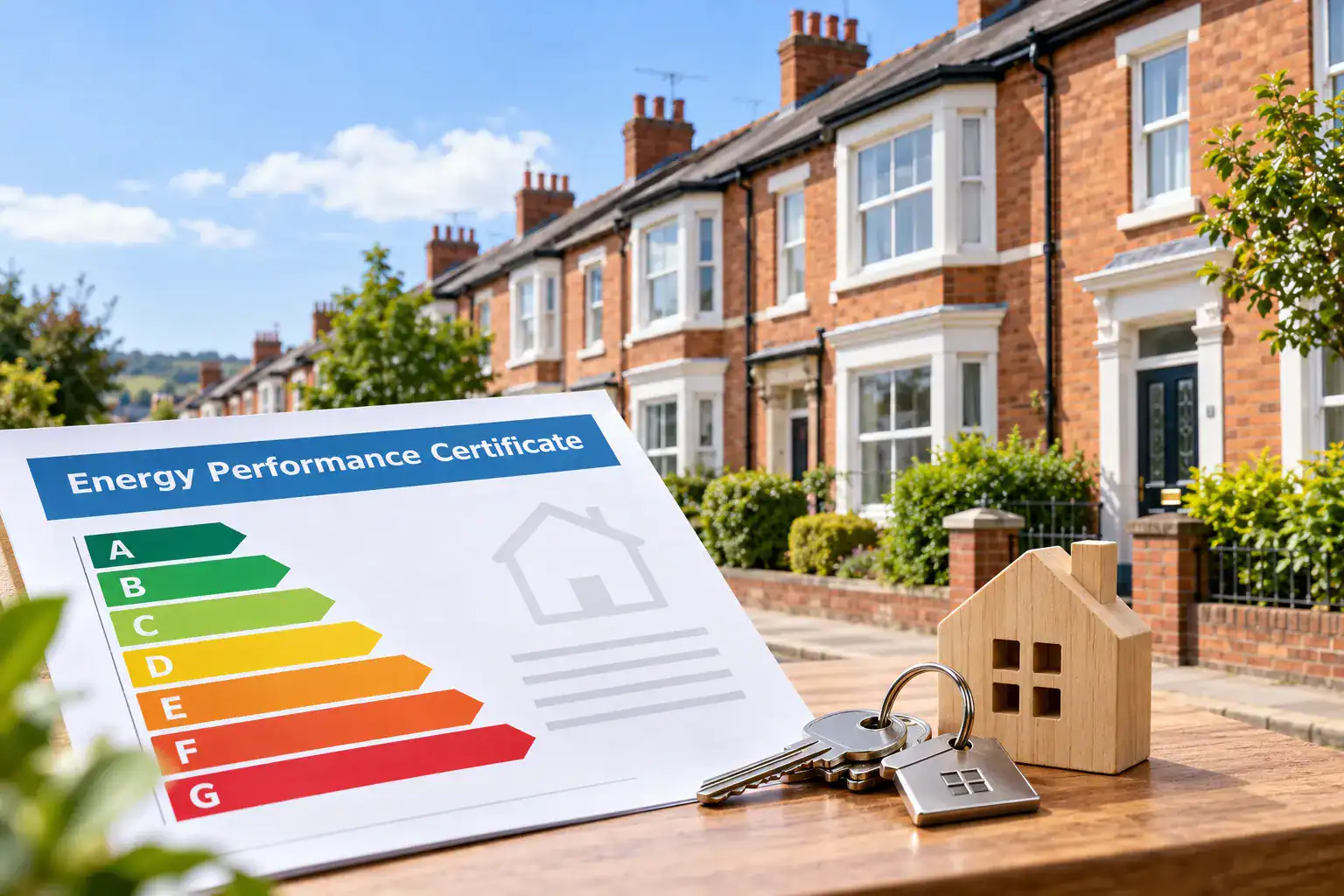
Energy Performance Certificates (EPCs) have been a legal requirement for most rental properties for many years. However, with further changes to energy efficiency standards planned for 2030, landlords need to understand both their current responsibilities and what they may need to do in the coming years.
Under current EPC regulations for landlords, most privately rented homes in England must achieve a minimum energy efficiency rating of E. The government has also confirmed plans to introduce higher standards by October 2030, which could mean additional improvements are needed for landlords whose properties currently fall below an EPC rating of C.
For landlords with properties in Rotherham, Sheffield and the surrounding areas, understanding these requirements now can help avoid unexpected costs and ensure rental properties remain compliant.
What is an EPC and why do landlords need one?
An Energy Performance Certificate (EPC) provides an assessment of a property’s energy efficiency. Properties are given a rating from A (most efficient) to G (least efficient), based on factors such as insulation, heating systems, windows and the building’s construction.
The certificate also includes recommendations for improving energy efficiency, together with estimated costs and potential savings.
EPCs are normally valid for 10 years and are required when most residential properties are sold or rented out.
Landlords must generally:
- Commission an EPC before marketing a property if there is no valid certificate.
- Make the EPC available to prospective tenants at the earliest opportunity.
- Provide a copy of the EPC to the successful tenant.
- Include the property’s energy efficiency rating in advertisements.
- Ensure the property meets the minimum energy efficiency standards, unless a valid exemption applies.
An EPC must be produced by an accredited domestic energy assessor.
Landlords can check whether their property already has a valid certificate using the government’s Find an energy certificate service.
What is the minimum EPC rating for rental properties in 2026?
The current minimum EPC rating for most privately rented residential properties in England is E.
This requirement forms part of the Minimum Energy Efficiency Standards (MEES), introduced under the Energy Efficiency (Private Rented Property) (England and Wales) Regulations 2015.
The regulations were introduced in stages:
- 1 April 2018: Landlords were generally prohibited from granting new tenancies for properties with an EPC rating below E, unless an exemption applied.
- 1 April 2020: The minimum E rating requirement was extended to existing tenancies, meaning landlords could no longer continue letting affected properties rated F or G without making improvements or registering an exemption.
These requirements remain in force in 2026.
If your rental property has an EPC rating of F or G, you will normally need to improve its energy efficiency before it can legally be let, unless it qualifies for an exemption.
Properties already rated A, B, C, D or E currently meet the minimum energy efficiency standard.
The rules apply to most privately rented homes that are legally required to have an EPC and are let under a tenancy covered by the regulations.
Full details are available in the government’s minimum energy efficiency standard guidance for landlords.
Are landlords required to achieve an EPC rating of C?
Not yet, but significant changes are planned.
In January 2026, the government published its response to a consultation on improving the energy performance of privately rented homes.
It confirmed plans to introduce higher minimum energy efficiency standards, with private landlords expected to meet the new requirements by 1 October 2030.
The intention is to bring privately rented properties up to a standard broadly equivalent to an EPC rating of C.
However, the new requirements will not simply rely on the existing A to G rating system.
How will the new EPC requirements work?
The government intends to introduce revised EPC assessments that provide more detailed information about a property’s energy performance.
Under the proposed regulations, landlords will need to meet:
- A primary standard based on the property’s fabric performance, including how effectively the building retains heat.
- A secondary standard based on either its heating system or smart readiness, with landlords able to choose which route to follow.
This approach is intended to give landlords greater flexibility when deciding which improvements to make.
For example, a landlord may be able to meet the secondary requirement through improvements such as solar panels or other suitable technologies, rather than replacing an existing heating system.
The government has made clear that landlords will not automatically be required to replace a working gas boiler with a heat pump.
What if my property already has an EPC rating of C?
The government’s plans include transitional arrangements for landlords who have already invested in improving their properties.
Under these proposals, a property with an EPC rating of C or above, assessed using the existing Energy Efficiency Rating system before 1 October 2029, would be treated as meeting the new requirements until that certificate expires or is replaced.
This is intended to recognise landlords who have already made improvements rather than requiring them to repeat work unnecessarily.
The proposed changes remain subject to parliamentary approval, so landlords should check the latest government guidance before committing to major expenditure.
The government’s full policy response can be found here:
Improving the energy performance of privately rented homes: Government response, January 2026
How much will landlords have to spend on EPC improvements?
The amount landlords are expected to invest depends on whether they are complying with the current regulations or preparing for the planned 2030 requirements.
Current EPC regulations: £3,500 cost cap
Under the existing MEES regulations, landlords are generally required to spend up to £3,500, including VAT, on relevant energy efficiency improvements where necessary to bring a property up to an EPC rating of E.
If the property still cannot achieve an E rating after all relevant improvements have been made within the cost cap, the landlord may be eligible to register an exemption.
Planned 2030 regulations: £10,000 cost cap
Under the government’s announced plans, the maximum required investment would increase to £10,000 per property over a 10-year period.
This would apply to relevant improvements needed to meet the new energy efficiency standards.
Importantly, £10,000 is a maximum investment requirement, not an amount every landlord will have to spend.
Some properties may already comply, while others could achieve the required improvements at a considerably lower cost.
The government’s January 2026 response estimated an average expenditure of approximately £5,400 per property to meet the higher standard, taking the proposed cost cap into account.
Where a property cannot meet the new requirements within the cap, landlords may be able to register an exemption.
The government has also proposed additional exemptions, including measures to protect landlords of lower-value properties from disproportionate improvement costs.
These changes are not yet part of the current £3,500 cost-cap rules.
What improvements can landlords make to increase their EPC rating?
The most appropriate improvements will depend on the age, construction and existing energy efficiency of the property.
Common measures include:
- Loft insulation: Improving insulation can reduce heat loss through the roof.
- Wall insulation: Cavity wall insulation or suitable solid wall insulation may improve thermal performance.
- Heating controls: Installing modern thermostats, programmers and thermostatic radiator valves can improve heating efficiency.
- Boiler and heating upgrades: More efficient heating systems may improve a property’s energy performance.
- Double glazing: Replacing older single-glazed windows can help reduce heat loss.
- Draught proofing: Addressing gaps around windows, doors and other openings can improve comfort and reduce heat loss.
- Low-energy lighting: Replacing inefficient lighting with LED alternatives can contribute to a better rating.
Not every improvement will be suitable for every property.
Older houses, particularly those with solid walls, may require a different approach from newer properties with cavity wall construction.
Before arranging major work, landlords should review the recommendations in their existing EPC and consider obtaining professional advice.
For properties requiring substantial improvements, it may also be worth commissioning an updated assessment before committing to expensive changes, particularly while the government is reforming the EPC system.
Are there exemptions from EPC regulations for landlords?
Yes. Certain properties may qualify for exemptions from the minimum energy efficiency requirements.
Under the current regulations, possible exemptions include circumstances where:
- The landlord has made all relevant energy efficiency improvements, but the property remains below the required rating.
- The cost of the cheapest recommended improvement exceeds the applicable cost cap.
- A required third party, such as a tenant or planning authority, refuses consent for particular improvements.
- An independent assessment demonstrates that specific improvements would reduce the property’s market value by more than the permitted threshold.
- Certain wall insulation measures are not appropriate for the property.
- A landlord has recently become responsible for a property in circumstances that qualify for a temporary exemption.
Exemptions are not automatic.
Landlords must register a valid exemption on the government’s Private Rented Sector (PRS) Exemptions Register before relying on it.
Supporting evidence may be required, and most exemptions have a limited period of validity.
Landlords can find further information through the official PRS exemptions guidance.
What happens if a landlord doesn’t comply with EPC regulations?
Landlords who fail to comply with the minimum energy efficiency standards can face financial penalties.
Under the current MEES regulations, local authorities can impose penalties for breaches, with the maximum financial penalty generally capped at £5,000 per property.
Penalties can arise where a landlord lets a property that does not meet the minimum standard and does not have a valid exemption.
There are also separate legal requirements relating to obtaining and providing EPCs when marketing or letting a property.
The government has announced plans to strengthen enforcement as part of the proposed 2030 changes, including increasing the maximum financial penalty for breaches of the minimum energy efficiency standards to £30,000 per property per breach.
This higher penalty is part of the planned reforms and is not the current maximum.
Do landlords need to renew an EPC every 10 years?
An EPC is normally valid for 10 years, but this does not necessarily mean landlords must automatically commission a new certificate on the day the existing one expires.
Under the current rules, a new EPC is generally required when a property is marketed for sale or rent if there is no valid certificate.
There are circumstances where an existing tenant can remain in occupation without the landlord immediately needing to obtain a replacement EPC.
However, the interaction between EPC expiry, tenancy arrangements and minimum energy efficiency requirements can be complicated.
The government is also considering changes to when valid EPCs will be required, including whether certificates should remain valid throughout private rented tenancies.
Landlords should therefore check the requirements applying to their particular property rather than assuming that an expired certificate can always be relied upon.
What should landlords do to prepare for the 2030 EPC changes?
Although the higher standards are not yet in force, landlords should start reviewing their properties rather than waiting until the proposed deadline approaches.
A sensible starting point is to:
- Check your current EPC rating. Confirm the rating and expiry date for each rental property.
- Review recommended improvements. Identify which measures could improve energy efficiency and their likely costs.
- Prioritise properties rated D or E. These properties currently meet the minimum standard but may require improvements under the planned regulations.
- Consider improvements alongside maintenance. If you are already replacing windows, renovating a property or upgrading heating, it may be more economical to incorporate energy efficiency measures at the same time.
- Keep records of improvement work. Retain invoices, certificates and other supporting documentation.
- Monitor government announcements. The detailed regulations and revised EPC assessment requirements are still being developed.
Landlords with several rental properties may benefit from planning improvements across their portfolio, allowing work to be scheduled and budgets managed over time.
There is no need to rush into expensive alterations before understanding how the revised assessment system will work.
EPC requirements for landlords: Frequently asked questions
Can I rent out a property with an EPC rating of D?
Yes. Under the current regulations, an EPC rating of D meets the minimum legal requirement for most privately rented residential properties in England.
However, properties rated D may need improvements to meet the higher energy efficiency standards planned for October 2030.
Can I rent out a property with an EPC rating of F or G?
Generally, no. Most properties covered by the MEES regulations must achieve at least an EPC rating of E.
A property rated F or G may only be let where a valid exemption applies or the property falls outside the scope of the relevant regulations.
Will landlords have to achieve EPC C by 2028?
No. Previous government proposals included an earlier deadline for improving energy efficiency in privately rented properties.
Those proposals were not implemented.
The current government’s announced target is for higher standards to apply to all relevant private rented tenancies by 1 October 2030, subject to the necessary legislation.
Will I need to replace my gas boiler to meet the new EPC requirements?
Not necessarily.
The proposed regulations are intended to allow landlords to choose between meeting a heating system standard and a smart readiness standard.
The government has specifically stated that landlords should not be forced to replace working heating systems with heat pumps simply to comply.
How long does an EPC last?
An EPC is normally valid for 10 years, unless a newer certificate is issued for the property.
Who is responsible for obtaining an EPC?
The landlord is responsible for ensuring the necessary EPC is obtained and provided when required.
A letting agent can arrange the assessment on the landlord’s behalf.
Need help managing your rental property?
Keeping up with changing landlord regulations is an important part of managing a rental property.
At Bricknells Rentals, we have over 27 years of experience in the South Yorkshire and North East Derbyshire property market, helping landlords manage their properties and understand their responsibilities.
From finding suitable tenants to ongoing property management, maintenance and refurbishment support, our experienced team can help landlords look after their investments.
If you would like advice about letting or managing your rental property, contact Bricknells Rentals to discuss how we can help.